For facility managers, warehouse directors, and procurement heads across the United Arab Emirates, handling bulk polymer byproducts has moved far beyond simple facility housekeeping. Industrial packaging, protective films, storage containers, and manufacturing trim accumulate rapidly across distribution hubs and production lines. Historically, some enterprises treated these redundant materials as routine rubbish to be cleared away as quickly as possible.
Today, however, commercial plastic recycling in Dubai is a serious corporate compliance, operational efficiency, and governance matter. Dubai Municipality enforces clear standards to divert industrial polymers away from municipal landfills, promote resource recovery, and keep commercial facilities aligned with environmental benchmarks. Handing plastic offcuts or bulk packaging to unregulated collectors exposes an organization to audit failures, administrative penalties, and reputational risk. Implementing a structured, traceable polymer recycling program is essential for maintaining smooth, fully compliant operations across the emirate.
What Counts as Commercial and Industrial Plastic Waste?
Commercial operations generate significantly different polymer waste streams than households. Industrial plastics are typically denser, higher in volume, and generated consistently during packaging, shipping, inventory de-consolidation, and light assembly.
Commercial and industrial facilities in Dubai commonly generate the following categories of recyclable polymers:
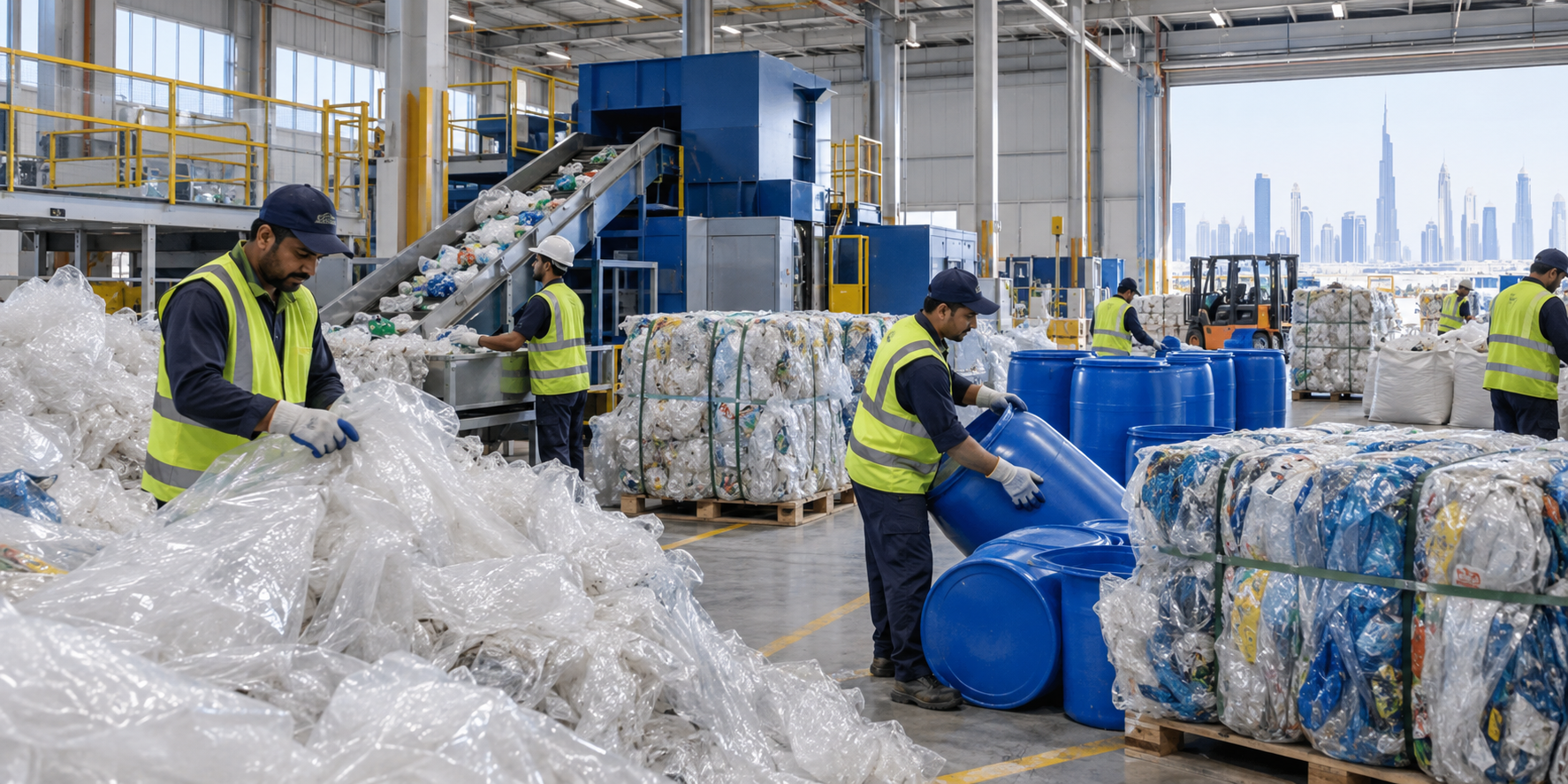
- Secondary and Tertiary Packaging: Polyethylene stretch film, pallet shrink wrap, bubble wrap, and plastic protective covers generated during unpacking and distribution activities.
- Rigid Polymer Containers: High-density polyethylene (HDPE) and polypropylene (PP) drums, storage carboys, intermediate bulk containers (IBCs), transport totes, plastic pallets, and logistics crates.
- High-Tensile Packaging Banding: Rigid Polyethylene Terephthalate (PET) straps and composite strapping used to secure heavy pallet loads and containerized cargo.
- Production Offcuts and Trim: Extrusion trimmings, injection molding sprues, thermoforming scrap edges, and surplus polymer cutoffs produced during standard manufacturing or packaging processes.
- Defective or Obsolete Stock: Unused plastic containers, non-conforming packaging components, and decommissioned plastic operational assets that must be safely cleared out of inventory.
Categorizing these materials at the facility level is the first practical step toward establishing an orderly, efficient recycling program.
The Compliance Imperative: Why Ad-Hoc Disposal Poses a Risk
In a fast-paced warehouse or industrial plant, the temptation can arise to clear floor space by engaging casual, unverified collectors who offer quick cleanups. However, ad-hoc disposal introduces distinct compliance and operational risks for Dubai businesses.
Dubai Municipality expects commercial entities to exercise full accountability over their commercial waste streams. When a business surrenders its plastic waste to informal handlers, several critical issues emerge:
- Loss of Chain of Custody: Unlicensed collectors do not provide verifiable records showing where the materials travel. If waste linked to your company is found dumped in non-designated areas or handled improperly, your enterprise can face municipal inquiries and regulatory fines.
- Inability to Pass Audits: Corporate governance frameworks, ISO certifications, and internal health, safety, and environment (HSE) standards require auditable documentation. Informal arrangements provide no paper trail, leaving compliance officers empty-handed during routine inspections.
- Exclusion from Tenders and Contracts: Multinational corporations, institutional clients, and government-affiliated entities routinely ask prospective vendors to prove their environmental and waste handling credentials. Relying on undocumented disposal can disqualify a business during competitive procurement rounds.
Treating commercial plastic recovery as a formal, traceable process mitigates regulatory liability and safeguards your corporate standing.
Why Proper Documentation Matters: The Value of Verified Certification
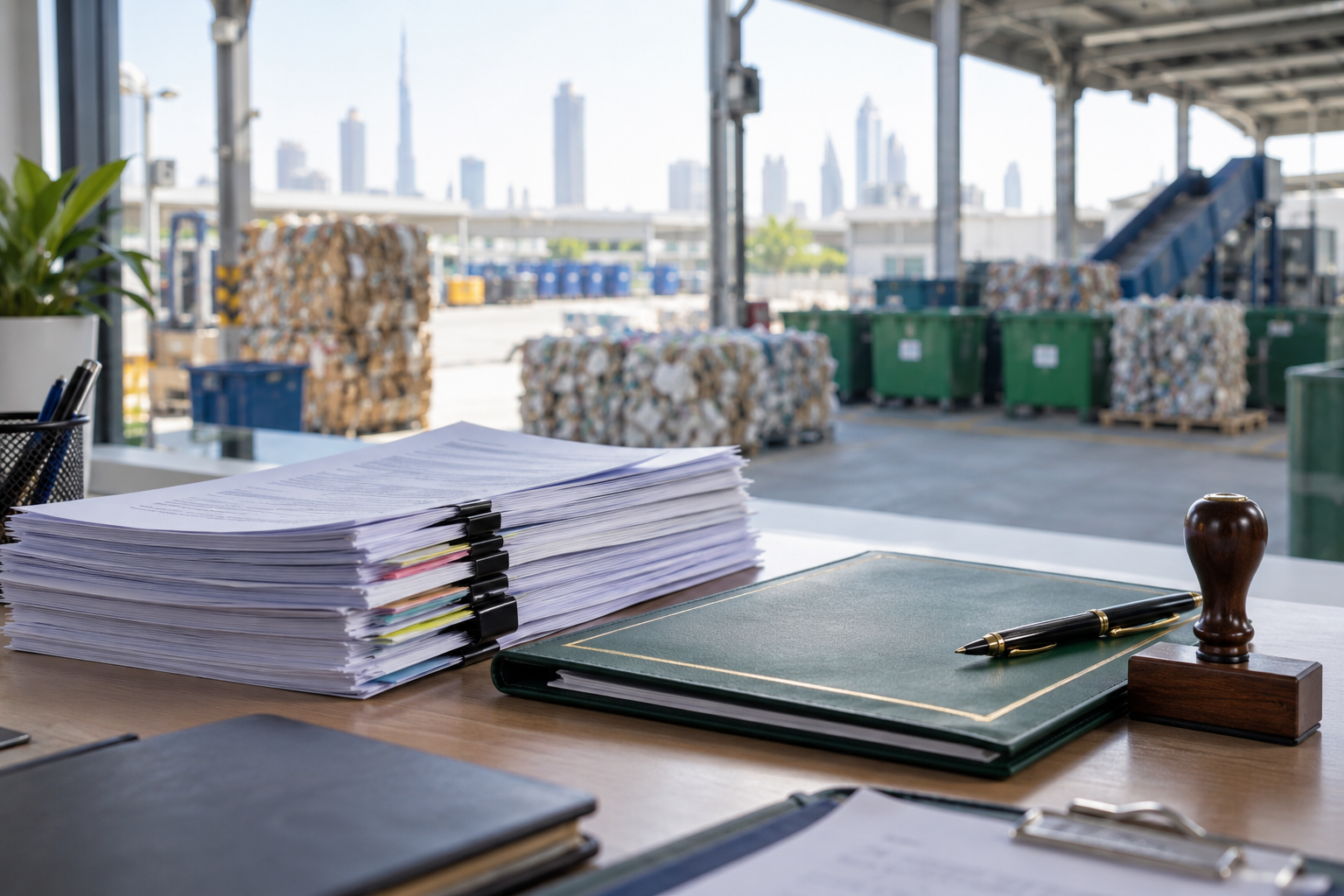
A structured recycling program is only as defensible as its paper trail. In Dubai’s regulated business landscape, obtaining official documentation for every collected batch of plastic is not merely a formality — it is an indispensable compliance asset.
When a company works through approved recycling channels, it receives formal documentation that details the full transaction:
- Material Breakdown: Specific identification of the polymer types processed.
- Accurate Weights: Net tonnage or kilograms collected and redirected from municipal disposal sites.
- Date and Facility Reference: Transparent records showing exactly when and where the materials were accepted for processing.
- Certificate of Recycling: A formal document issued by an authorized facility attesting that the materials were processed for material recovery.
These records serve multiple vital functions. They provide concrete evidence during municipal audits, validate sustainability disclosures for corporate reports, and fulfill vendor compliance requirements for high-profile client contracts.
What the Commercial Plastic Recycling Process Involves
The steps below reflect how a compliant recycling process generally works — the exact handling for your specific materials and facility is best confirmed during a recycling assessment call.
Understanding how industrial plastic moves from a warehouse floor back into productive use helps facility managers integrate recycling smoothly into daily routines. A professional recycling process follows several distinct, controlled phases:
On-Site Segregation → Consolidated Collection → Mechanical Sorting → Processing & Granulation → Certification
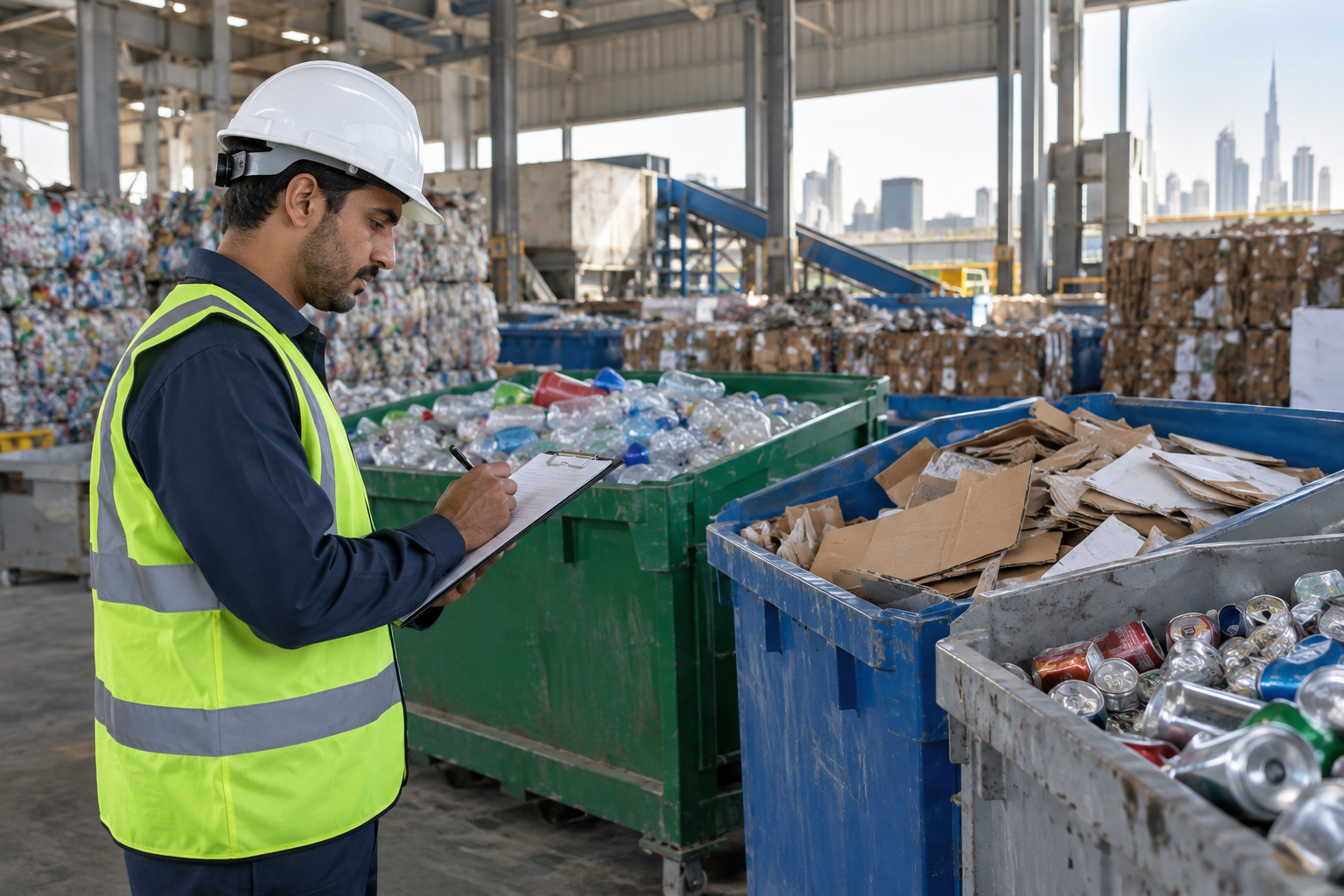
1. On-Site Segregation and Collection The process begins inside the commercial facility. Clean plastic packaging films, rigid drums, production trim, or severed strapping are separated from general refuse at the point of generation. Placing plastics into designated bins, bulk bags, or balers prevents contamination from food, liquids, or general dust. Once scheduled, an approved transport vehicle collects the segregated materials directly from the site.
2. Inspection and Sorting Upon arrival at the processing facility, technicians inspect the shipment to verify polymer categories and remove foreign contaminants such as labels, fasteners, dirt, or residual fluids. Homogeneous sorting is essential, as distinct polymers — such as HDPE, PP, and PET — possess different melting profiles and processing requirements.
3. Processing and Size Reduction Sorted plastics are fed into heavy-duty industrial granulation equipment. The machinery mechanically reduces large plastic parts, containers, strapping, and sheets into uniform, free-flowing flakes or regrind.
4. Washing and Material Recovery The granulated polymer flakes undergo thorough industrial washing to remove surface residues, warehouse grime, and adhesives. Once dried and classified, the clean regrind is consolidated into secondary industrial feedstocks. These recycled raw materials are reintroduced into commercial manufacturing streams to produce new packaging materials, construction supplies, industrial components, and durable goods.
5. Final Reporting and Issuance of Certification After processing is complete, the recycling partner issues formal recycling certificates, closing the loop and providing the client with an auditable record of diversion.
How to Choose a Compliant Recycling Partner in Dubai
Not all service providers operate at the same regulatory standard. When selecting a commercial plastic recycling partner for your facility, procurement and HSE teams should review prospective vendors against the following criteria:
- Dubai Municipality Approval: Ensure the recycling company is formally approved by Dubai Municipality to accept and process commercial polymer waste. Approved status confirms that their processing facility, material-handling systems, and transport logistics satisfy municipal operating guidelines.
- Comprehensive Certification Standards: The partner must provide standardized, verifiable documentation for every collection, rather than vague delivery receipts or verbal assurances.
- Capacity for Commercial Volumes: The company should have the logistical fleet, container infrastructure, and processing throughput capable of handling regular, high-volume palletized loads, packaging offcuts, and bulk containers without causing operational backlogs on your premises.
- Transparent Traceability: Look for a partner that operates with full transparency regarding how materials are processed and diverted into secondary manufacturing streams.
Arrange Your Commercial Plastic Recycling Assessment with Ecocleaner
Establishing an organized, fully compliant polymer recovery workflow simplifies warehouse operations, safeguards your business against municipal compliance risks, and provides the documentation needed for corporate reporting.
Based in Dubai Industrial City, Ecocleaner Recycling LLC is a Dubai Municipality-approved recycling and secure destruction company supporting commercial facilities, warehouses, and manufacturing plants across the UAE. Our team assists businesses in transitioning away from unverified disposal practices toward clear, traceable polymer recovery workflows.
Contact the team at Ecocleaner Recycling LLC today to schedule an on-site recycling assessment or arrange a scheduled pickup for your commercial plastic materials.